| Class Iso 146144-1 (Standard 209E) | Average Airflow Velocity | Air Changes Per Hour |
| ISO 8 (Class 100,000) | 0.005 - 0.041 m/sec (1 - 8 ft/min) | 5 - 48 |
| ISO 7 (Class 10,000) | 0.051 - 0.076 m/sec (10 - 15 ft/min) | 60 - 90 |
| ISO 6 (Class 1,000) | 0.127 - 0.203 m/sec (25 - 40 ft/min) | 150 - 240 |
| ISO 5 (Class 100) | 0.203 - 0.406 m/sec (40 - 80 ft/min) | 240 - 480 |
| ISO 4 (Class 10) | 0.254 - 0.457 m/sec (50 - 90 ft/min) | 300 - 540 |
| ISO 3 (Class 1) | 0.305 - 0.457 m/sec (60 - 90 ft/min) | 360 - 540 |
| ISO 1-2 | 0.305 - 0.508 m/sec (60 - 100 ft/min) | 360 - 600 |
on
the application and floor plan. Source: Institute of Environmental Science
| Class | Ceiling Coverage |
| ISO 8 (Class 100,000) | 5 - 15% |
| ISO 7 (Class 10,000) | 15 - 20% |
| ISO 6 (Class 1,000) | 25 - 40% |
| ISO 5 (Class 100) | 35 - 70% |
| ISO 4 (Class 10) | 50 - 90% |
| ISO 3 (Class 1) | 60 - 100%* |
| ISO 1-2 | 80 - 100%* |
depending on the application and floor plan.
* ULPA filters required in Class 1/10 applications. HEPA filters
required for all others.
AIR CHANGES PER HOUR CALCULATOR
| Calculation of air volume The volume of air required to operate a ventilating and cooling system is a very fundamental requirement. Before air volume is estimated or calculated, careful consideration should be given to the following factors. The objectives of the ventilation system The budget Alternate methods of Rate of air change method |  Typical layout of fans for rate of air change method Although the rate of air change method of calculating air volume has been used for many years, American Coolair engineers have found it unsatisfactory except in relatively small buildings or rooms. For jobs that involve personnel comfort. this method is not recommended if the building is over 50,000 cubic feet in content or more than l00' in length. CFM per square foot of floor area method adaptation of the rate of air change formula. Total air volume (cubic feet per minute) is determined by multiplying the total square feet of floor area by an arbitrary CFM per square foot figure. The figure selected may be as low as 2 CFM or as high as 12 CFM per square foot. Four CFM per square foot has been recom mended as a minimum for summer ventilation of large assembly type operations. the rate of air change method, is likely to produce unsatisfactory results in many cases. Failure to control air distribution and air velocity can be a major weakness in the whole concept. Selection of a CFM per square foot figure should be based on experience and a proven method of air distribution. Rate of air velocity method needed for a system is highly recommended by American Coolair. A breeze conditioning system can be highly effective in providing personnel comfort in hot weather if the recommendations outlined below are observed. It has been determined from field experience that an average air velocity of 150 feet per minute (FPM) to 200 FPM is usually sufficient for personnel cooling under summertime conditions. The CFM required to do the job is calculated by multiplying the cross section of an area through which the air is to move by the desired velocity. This is expressed in the following formula.
| |||
| CFM = (cu. ft./min.) | Area to be cooled (cubic feet)* | |||
| | ||||
| Recommended rate of air change (minutes) | ||||
| * Area to be cooled (cu. ft.) = Length (ft.) x Width (ft.) x Average Ceiling Height (ft.) Example: A laundry 100' long by 30' wide with a 15' ceiling height requires a complete air change each 1/2 minute. The necessary air volume (fan capacity) is de determined from the above formula as follows: | ||||
| CFM = | 100 x 30 x 15 | = 90,000 cu. ft. / min. | ||

How to calculate air change rates
How to calculate air change rates - air
change rate equations in imperial
and SI units
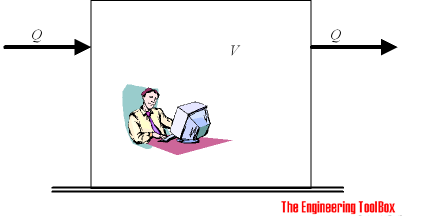
Air Change Rate - Imperial Units
Air change rate per hour can be expressed in imperial Units as
n = 60 Q / V (1)
where
r = air change rate per hour
Q = fresh air flow through the room (Cubic Feet per Minute (cfm))
V = volume of the room (Cubic Feet)
Air Change Rate - SI Units
Air change rate expressed in SI-units:
n = 3600 Q / V (2)
where
r = air change rate per hour
Q = fresh air flow through the room (m3/s)
V = volume of the room (m3)
Example - Air Change Rate SI Units
With an air flow of 3 m3/s in a 20000 m3 room the air flow rate can
be calculated as
n = 3600 3 (m3/s) / 20000 (m3)
= 0.54

No comments:
Post a Comment